Past the Obvious Stop
Tucked beneath cathedral flags, flooded beneath alpine lakes, or deep inside subterranean halite seams, these locations defy traditional sightseeing categories.
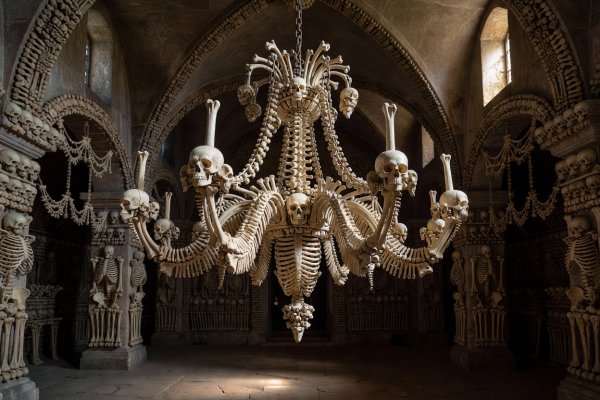 Central Bohemia, Czechia
Sedlec Ossuary
Located in the suburb of Kutná Hora, the Cemetery Church of All Saints conceals a small gothic crypt. Following the 14th-century Black Death and 15th-century Hussite Wars, the churchyard graveyard overflowed with tens of thousands of bodies. Around 1511, a blind monk was assigned to exhume and stack bones into six massive pyramid mounds.
In 1870, the noble Schwarzenberg family commissioned local woodcarver František Rint to bring order to the bone piles. Rint sanitized, bleached, and fashioned the skeletons into monumental architectural forms: decorative wall garlands, candle chalices, the Schwarzenberg coat of arms, and an elaborate centre chandelier containing at least one of every single bone in the human skeleton.
- Estimated Remains: 40,000 to 70,000 individuals
- Artisan: František Rint (signature executed in bones)
- Status: Consecrated Catholic chapel
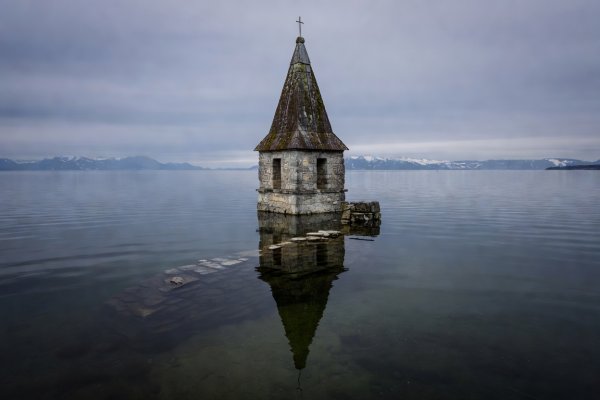 South Tyrol, Italy
Reschensee: The Drowned Campanile
In the Vinschgau valley near the Reschen Pass, a solitary fourteenth-century stone bell tower emerges silently from the dark turquoise surface of Lake Reschen. This picturesque Alpine lake is an artificial reservoir created in 1950 by the Montecatini electric utility.
Despite fierce protests from local farmers and residents, a huge dam merged two natural lakes (Reschensee and Mittersee) and raised the water level by 22 metres. The historic village of Graun (Curon Venosta) and part of Reschen were submerged, destroying 523 hectares of farmland and dislocating over 150 families. While all houses and the church body were dynamited, the medieval bell tower had historic monument protection and was spared demolition.
- Campanile Date: Built 1357 CE
- Submersion Date: Summer 1950 CE
- Winter Condition: Water freezes completely, accessible on foot
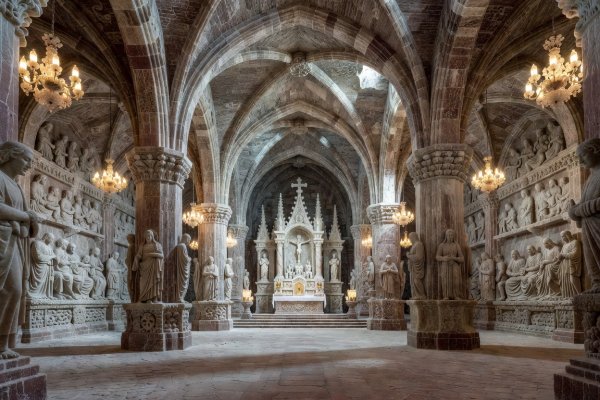 Lesser Poland, Poland
Wieliczka Salt Mine
Operating continuously from the thirteenth century until 2007, the Wieliczka Salt Mine descends nine levels down to a depth of 327 metres, containing over 287 kilometres of tunnels. It is not just an industrial relic; over centuries, miners carved whole religious sanctuaries from solid grey rock salt.
The centrepiece is the Chapel of Saint Kinga, situated 101 metres below ground. Spanning 54 metres in length, everything within it—from the altars and bas-relief reproductions of Da Vinci's Last Supper to the delicate chandeliers—is fashioned from translucent sodium chloride crystals.
- Depth: 64 m to 327 m underground
- UNESCO Listing: 1978 (First World Heritage list)
- Key Feature: Chapel of St. Kinga (sculpted 1896–1963)