After the Residents Left
Towns in Europe do not empty by chance. When military siege, landslide collapse, or wartime destruction struck, these settlements were intentionally left untouched as open-air archives.
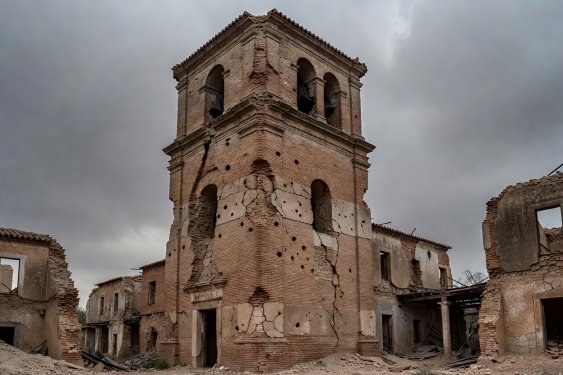 Zaragoza, Spain
Belchite: Pueblo Viejo
Forty kilometres south of Zaragoza sits the silent ghost city of Belchite. In August and September of 1937, the town became the epicentre of a brutal 14-day battle during the Spanish Civil War. Over 5,000 combatants died within its tight streets, and heavy artillery pulverized the historic buildings.
Following the war, the Francoist regime decided against rebuilding the damaged town. Instead, a new town (Pueblo Nuevo) was erected adjacent to it, leaving the original historic settlement as a national ruin. Walking through the Calle Mayor reveals collapsed baroque roofs, pierced bell domes, and exposed brick arcades where shell craters remain preserved exactly as they landed.
- Destruction Event: Battle of Belchite (1937)
- Access Format: Controlled historical tours
- Protection: Bien de Interés Cultural
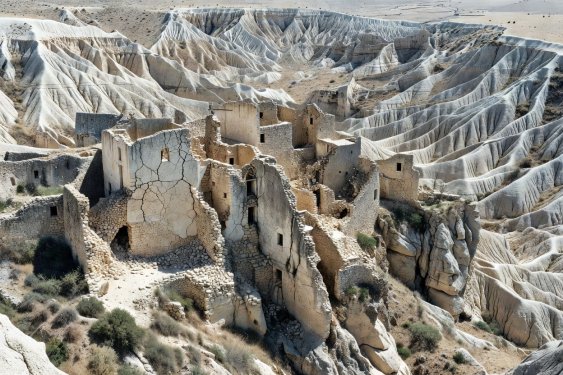 Basilicata, Italy
Craco: The Disintegrating Clifftop
Perched high on a 400-metre hill overlooking the Cavone River valley in southern Italy, Craco looks like an organic continuation of the rock itself. First recorded in the eighth century, this fortified Norman town withstood medieval conflicts, banditry, and plague, but ultimately succumbed to its own foundation.
The hill of Craco sits atop unstable Pliocene clays prone to calanchi (arid gullying). In 1963, a series of catastrophic landslides caused by ill-conceived public sewer works destabilized the slope, forcing the evacuation of 1,800 residents down to Craco Peschiera. A subsequent 1972 flood and the 1980 Irpinia earthquake rendered reoccupation completely impossible.
Today, visitors equipped with safety helmets can traverse secured routes along empty cobbled streets, gazing into frescoed dining halls open to the winds.
- Evacuation Trigger: Landslides (1963) and earthquake (1980)
- Geology: Pliocene clay with calcarenite cap
- Current Status: Secured historical park with hardhat access
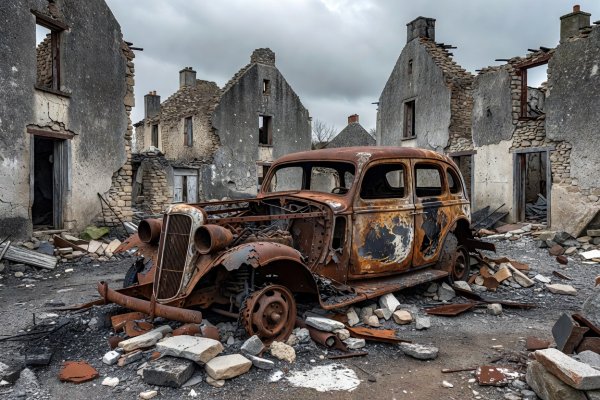 Haute-Vienne, France
Oradour-sur-Glane: The Frozen Village
On the afternoon of June 10, 1944, soldiers of the 2nd SS Panzer Division Das Reich entered the quiet farming village of Oradour-sur-Glane. By evening, 643 civilians—men, women, and children—had been systematically murdered, and every house, bakery, workshop, and school was burned to the ground.
After the Liberation, General Charles de Gaulle declared that Oradour should never be cleared or rebuilt. It remains today exactly as it stood that evening: rusted sewing machines rest on bedroom hearths, tram tracks cross the central street, and charred automobiles remain parked behind stone walls marked with "Souviens-Toi" (Remember).
- Historical Event: June 10, 1944 massacre
- Preservation: French National Monument under state protection
- Adjacent Site: Centre de la Mémoire d'Oradour